
Bolt locking for hygienic equipment: what 3-A and EHEDG actually allow
Which locking devices are excluded, and why
| Device | Why it is excluded from hygienic equipment |
|---|---|
| Nylon-insert (nyloc) nut | Polymer foreign-body source; insert-to-thread crevice harbours bacteria; 120 °C ceiling, below SIP |
| Serrated flange nut | Creates scored, un-cleanable surfaces by design |
| Lock wire, castellated nut and cotter pin | Crevices, snag hazard, cannot be cleaned |
| Split / spring washer | Crevice, and ineffective as a locking device |
| Anaerobic threadlocker | Not food-contact approved unless specifically NSF-registered; cure inhibited on passivated stainless |
| Wedge-locking washer pair | Radial teeth destroy the passivation layer, creating a corrosion and harbourage site on 316L |
| Double nut | Additional crevice and an additional un-cleanable interface |
Why hygienic bolted joints fail even when nothing rotates
CIP and SIP run daily: ambient to 85 °C caustic, back to ambient, then 140 °C steam. Eraliev et al. measured 41 % preload loss in the first 20 → 120 °C cycle with nut rotation of order 5 × 10⁻⁴ degrees. The nut effectively does not move, so no rotational locking device changes the outcome.
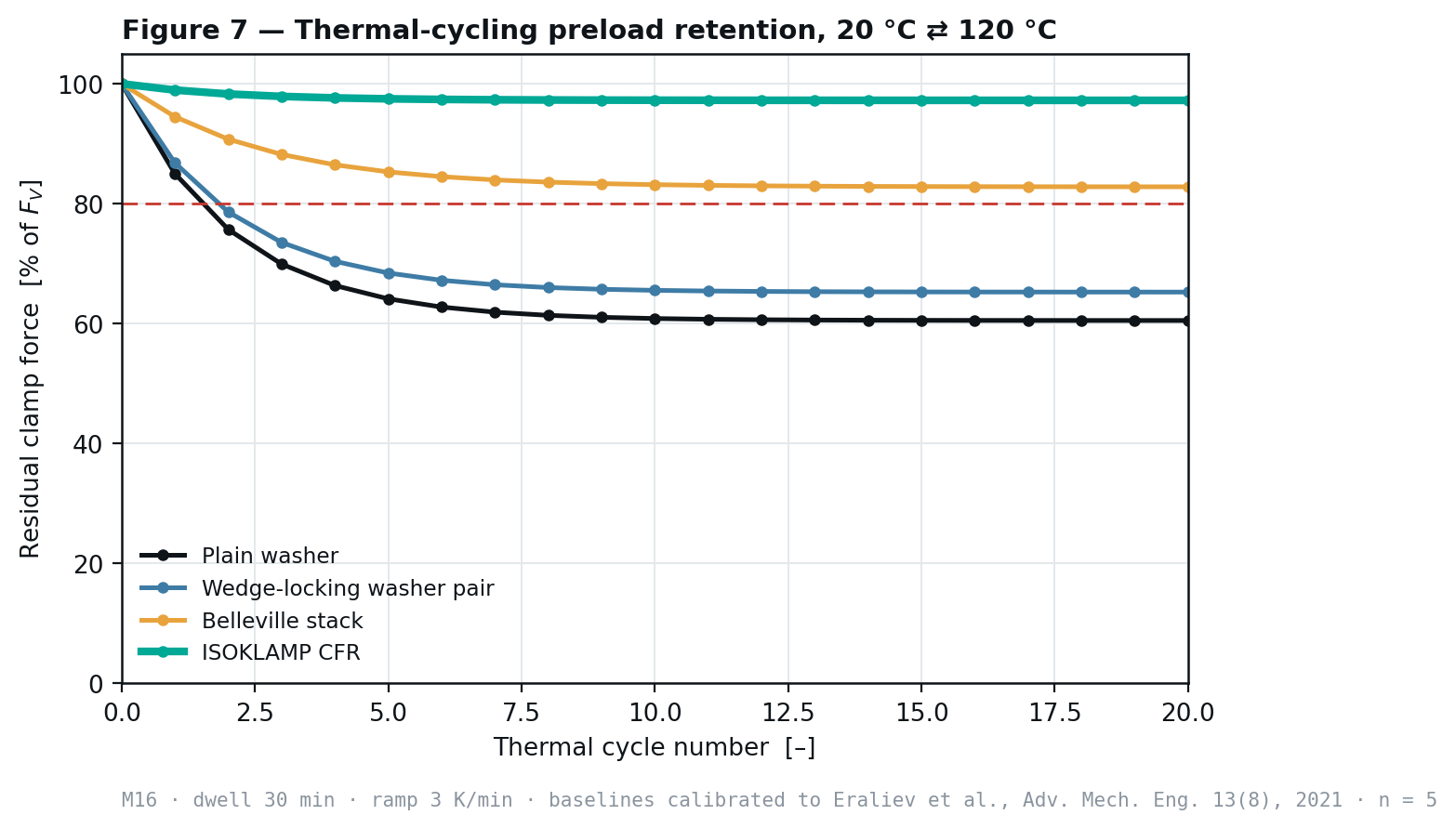
| Thermal cycle | Plain washer | Wedge-locking pair | Belleville stack | ISOKLAMP CFR |
|---|---|---|---|---|
| 1 | 85,0 % | 86,8 % | 94,5 % | 98,9 % |
| 5 | 66,7 % | 69,3 % | 84,4 % | 97,1 % |
| 10 | 56,9 % | 59,9 % | 78,3 % | 95,9 % |
| 20 | 51,3 % | 54,5 % | 74,4 % | 95,1 % |
Note the second column. A wedge-locking washer tracks a plain washer almost exactly, because it is a rotational locking device and this is not a rotational failure.
Stainless galling — why re-torquing makes it worse
Austenitic stainless can go “from smooth rotation to complete seizure within a fraction of a turn.” Every prevailing-torque device adds exactly the friction and heat that trigger it, and nyloc nuts in stainless are singled out in the literature as particularly susceptible. A maintenance strategy built on repeated re-torquing of stainless fasteners is a galling strategy.
The equipment where this matters most
Homogenisers · separators and centrifuges · vibrating sieves and sifters · filling and capping heads · pump and agitator mounts · guards, frames and supports in wash-down zones · spray dryers · plate heat exchanger frames.
Common factor: real mechanical vibration, daily aggressive thermal cycling, stainless everywhere, and a validated envelope you are not free to open.
What a hygienic-compatible locking element has to be
All metal, no polymer, no adhesive · no crevice-forming geometry · smooth, cleanable, drainable surfaces · no teeth that damage passivation · no prevailing torque · no re-torque dependency · verifiable without opening the equipment.
Is ISOKLAMP certified?
Questions
- What bolt locking do 3-A and EHEDG allow?
- Hygienic design rules exclude almost the entire bolt-locking catalogue. Nylon inserts are a foreign-body and harbourage risk, serrated devices create un-cleanable scored surfaces, lock wire and split washers form crevices, most threadlockers are not food-contact approved, and wedge-locking washers destroy the passivation layer on 316L with their teeth. What remains is correct preload, food-grade anti-seize and a re-torque schedule.
- Why do hygienic bolted joints keep loosening?
- CIP and SIP put the joint through more than 300 thermal cycles a year, and thermal cycling removes preload without the nut turning at all. Eraliev et al. measured 41 % preload loss in the first 20 to 120 °C cycle with nut rotation of order 5 × 10⁻⁴ degrees, so no rotational locking device changes the outcome.
- Is ISOKLAMP 3-A or EHEDG certified?
- No. ISOKLAMP CFR is designed to hygienic-design principles — all-metal 316L, no polymer, no adhesive, smooth ground bearing faces, no crevice-forming geometry — and third-party assessment is in progress. It does not currently hold 3-A, EHEDG or NSF certification and must not be specified as if it does.