
A washer that re-tightens itself
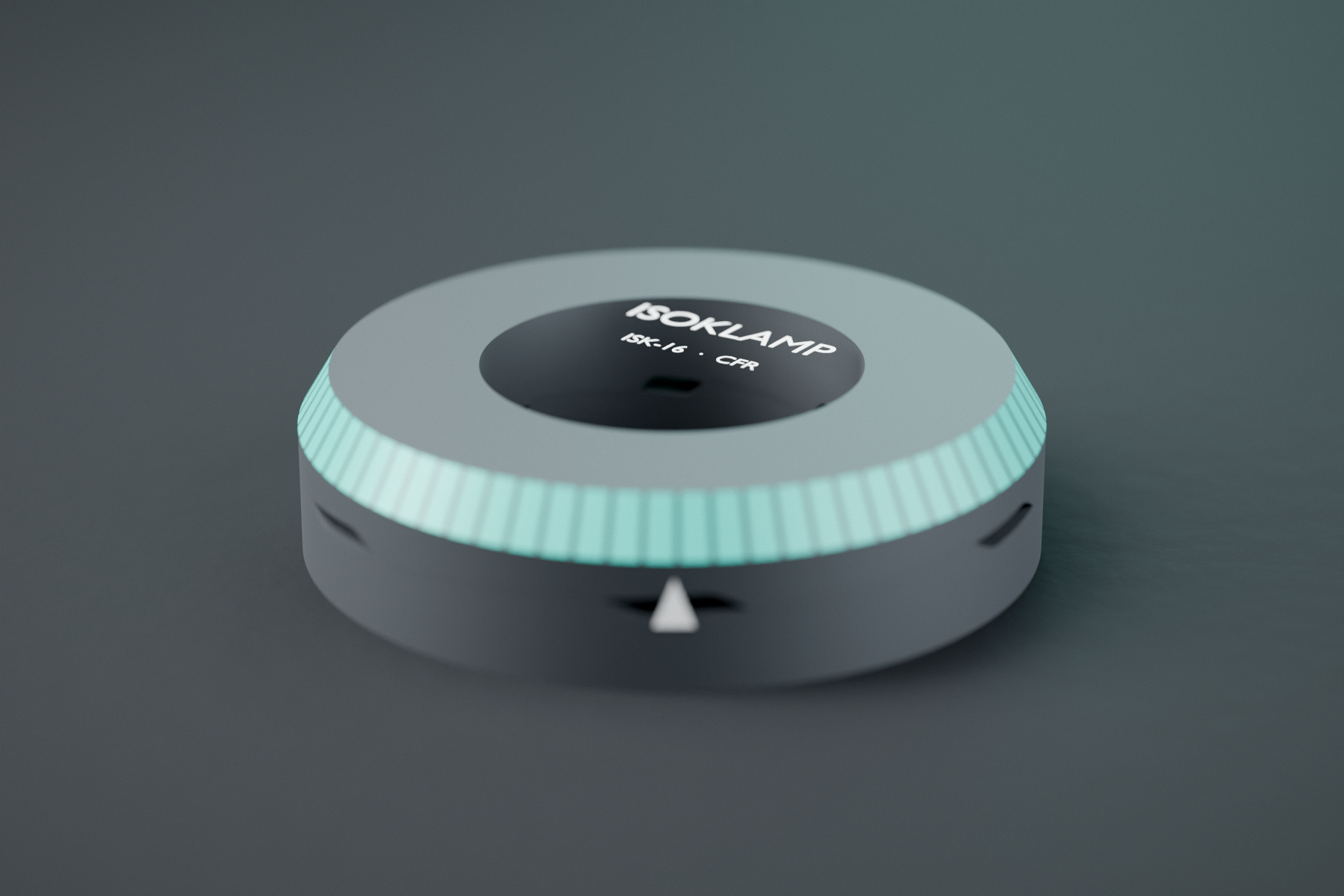
Why would a washer need to re-tighten itself?
Because bolted joints lose clamp force without anything unscrewing.
Embedment flattens the microscopic peaks on every bearing surface in the stack. Zinc and paint coatings creep under pressure. Gaskets relax. Thermal cycling ratchets the load down a little on every cycle. Fretting slowly wears the interfaces. Every one of these makes the clamped stack shorter, and none of them turns the nut.
A bolt is a very stiff spring. On an M16 joint with a 27 mm grip, the equivalent stiffness is about 627 kN/mm, so 30 µm of stack shortening removes 18,8 kN — 26,9 % of a 70 kN preload. That is a third of the width of a human hair, and it is less than the embedment allowance VDI 2230 tells you to design for.
Published magnitudes: cyclic plastic ratcheting in the first engaged threads costs 10–40 % within 200 cycles. Zinc coating creep, about 20 %. Elastomer gasket relaxation, 55–65 %. A single 20 → 120 °C thermal cycle at low preload, 41 %.
Re-torquing is the conventional answer. It works, it is expensive, and it tells you nothing about what the clamp force was before you touched it.
How the self-tightening mechanism works
Four elements, none of them exotic.
The drive ring and the base ring share a multi-start helical ramp with a lead angle of 4,5°. All clamp load passes through this interface.
A pre-wound constant-torque spiral sits in a sealed annular pocket in the base ring. Its torque is engineered flat across a 340° stroke, of which the drive ring uses only the first 30° — which is why the force it delivers is constant to within ±2 % across the entire take-up reserve. It is not in the load path. Its only job is to hold a constant torque urging the drive ring up its ramp.
When the stack gets shorter, the ring advances and the assembly gets thicker by exactly the amount the stack lost. Clamp length is restored. Clamp force is restored.
The reserve indicator is free: because take-up is a rotation, the relative angular position of the two rings records exactly how much compensation has been used.

Where the energy comes from — vibration is the actuator
There is an apparent paradox here. If the ramp is self-locking, what advances it?
The ramp is self-locking against axial load. It is not locked against rotation at the moment the circumferential friction budget at the bearing face is spent.
During transverse micro-slip the friction vector at the bearing face reorients into the transverse direction and circumferential restraint collapses toward zero. In a conventional joint, that instant is when the nut backs off. In an ISOKLAMP joint it is the instant the bias torque advances the drive ring, before stick re-establishes and latches the gain.
The device compensates fastest in exactly the service conditions that loosen a conventional joint fastest.
Under a genuinely static joint the spiral simply holds its bias and the assembly behaves as a conventional hardened washer pair, which is correct, because a static joint does not self-loosen.

Why it cannot loosen back off
Two geometric conditions, both of which must hold.
CONDITION 1 — anti-rotation
    α_c  >  β        4,50°  >  2,48°   (M16 × 2,0)

CONDITION 2 — one-way take-up
    tan α_c  <  µ_r        0,079  <  0,11 … 0,16
Condition 1 is the wedge principle. Because the ramp rises faster than the thread, the nut cannot rotate backwards without lifting the drive ring further up its own ramp, which elongates the bolt and increases clamp force. Reverse rotation is opposed geometrically, not frictionally, and is therefore indifferent to lubrication of the thread or the bearing face.
Condition 2 is what no wedge washer has. Because the ramp is self-locking, the assembly cannot be pushed back down. Take-up is a ratchet with no teeth: continuous in resolution, irreversible in direction.

How much can it recover?
| Size | Take-up reserve | Ramp α_c | Thread lead β | Margin |
|---|---|---|---|---|
| ISK-08 (M8) | 0,30 mm | 4,50° | 3,17° | 1,33° |
| ISK-12 (M12) | 0,40 mm | 4,50° | 2,94° | 1,56° |
| ISK-16 (M16) | 0,50 mm | 4,50° | 2,48° | 2,02° |
| ISK-20 (M20) | 0,60 mm | 4,50° | 2,48° | 2,02° |
| ISK-24 (M24) | 0,75 mm | 4,50° | 2,48° | 2,02° |
| ISK-36 (M36) | 1,10 mm | 4,50° | 2,18° | 2,32° |
The reserve is sized at roughly three times the predicted 25-year stack shortening for the qualified application envelope. Typical lifetime relaxation in a coated, gasketed, thermally cycled metal joint is 30 to 150 µm; the M16 reserve is 500 µm.
Is this the same as a spring washer or a disc spring?
No, and the difference is the whole design.
A helical spring washer flattens at 10 to 20 % of typical preload and then behaves as a plain washer. Published tests show some accelerate loosening. The DIN standards were withdrawn in 2004.
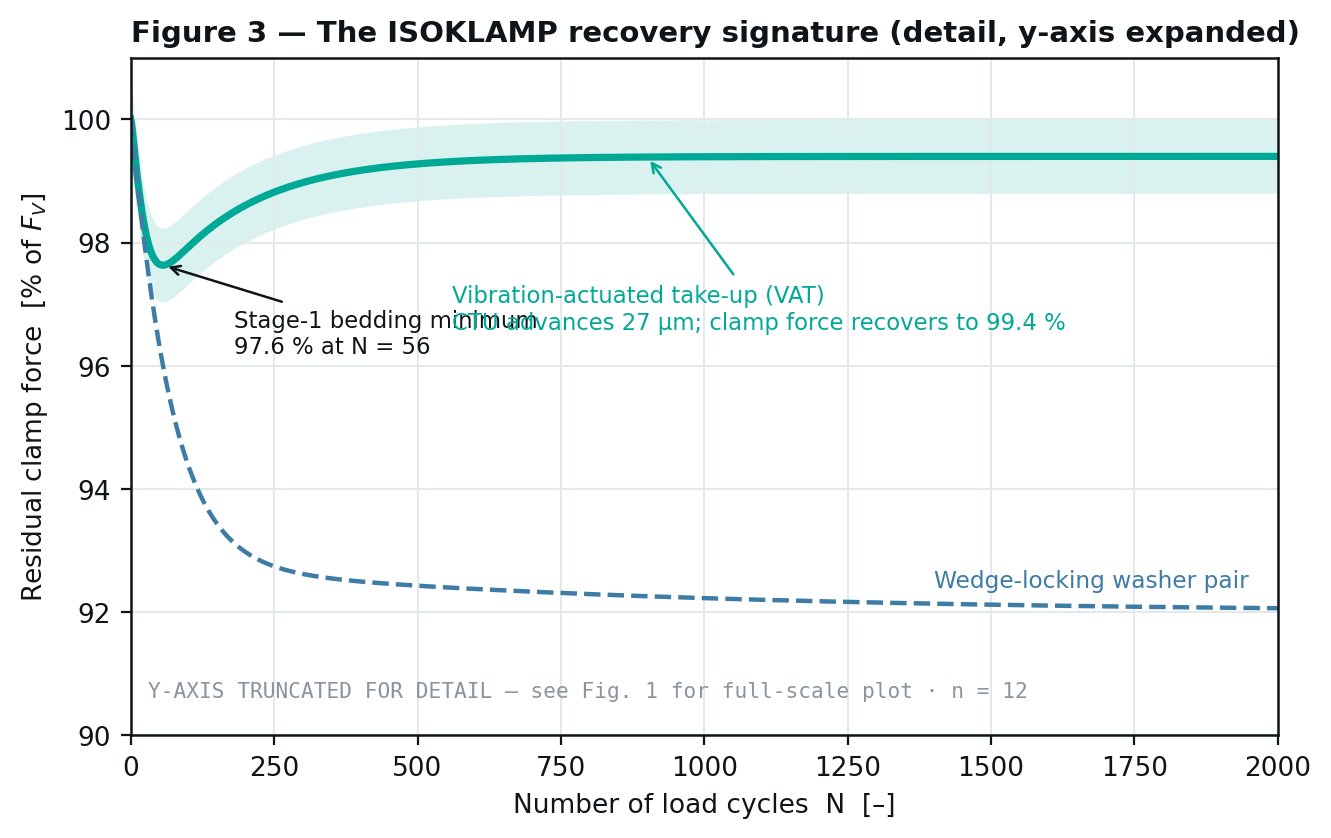
A Belleville disc spring genuinely does compensate relaxation — it retains 68,7 % of clamp force at 150 µm of stack shortening where a rigid stack is at zero. The cost is fatigue. A disc spring is compliant in both directions at all times, so it raises the load factor Φ from 0,21 to 0,82, meaning the bolt absorbs roughly four times more of every external load cycle.
ISOKLAMP is compliant in one direction only, and latches afterwards. Quasi-statically it is 44× softer than a rigid stack, so relaxation costs almost nothing. Dynamically it is as stiff as solid steel, so Φ stays at 0,27.
Soft where you want compliance. Stiff where you do not. A linear spring cannot tell the difference. A one-way latch can.
Has it been tested?
We publish it this way deliberately. A pre-revenue company presenting accredited test series it has not run gets found out by the first specifier who asks for the laboratory report number, and specifiers ask.
Questions
- Is there a washer that re-tightens itself?
- Yes. ISOKLAMP CFR is a two-part washer that restores its own clamp load. Its two rings share a self-locking helical ramp at 4,5°, biased by a pre-wound constant-torque spiral. Each time the joint micro-slips under vibration, the upper ring advances up the ramp by at most 0,02° — about 0,34 µm of stack height — and then latches, because the ramp cannot be back-driven (tan 4,5° = 0,079, below the ramp friction coefficient of 0,11–0,16). All performance figures on this site are model-predicted; independent testing is scheduled.
- How does a self-tightening washer work?
- Four elements, none of them exotic. The drive ring and the base ring share a multi-start helical ramp with a lead angle of 4,5°. All clamp load passes through this interface. A pre-wound constant-torque spiral sits in a sealed annular pocket in the base ring. Its torque is engineered flat across a 340° stroke, of which the drive ring uses only the first 30°, which is why the force it delivers is constant to within ±2 % across the entire take-up reserve. It is not in the load path. Its only job is to hold a constant torque urging the drive ring up its ramp. When the stack gets shorter, the ring advances and the assembly gets thicker by exactly the amount the stack lost. Clamp length is restored. Clamp force is restored.
- Can a washer restore bolt preload after it has been lost?
- The reserve is sized at roughly three times the predicted 25-year stack shortening for the qualified application envelope. Typical lifetime relaxation in a coated, gasketed, thermally cycled metal joint is 30 to 150 µm; the M16 reserve is 500 µm.
- Is a self-tightening washer the same as a spring washer?
- No, and the difference is the whole design. A helical spring washer flattens at 10 to 20 % of typical preload and then behaves as a plain washer. Published tests show some accelerate loosening. The DIN standards were withdrawn in 2004. A Belleville disc spring genuinely does compensate relaxation, it retains 68,7 % of clamp force at 150 µm of stack shortening where a rigid stack is at zero. The cost is fatigue. A disc spring is compliant in both directions at all times, so it raises the load factor Φ from 0,21 to 0,82, meaning the bolt absorbs roughly four times more of every external load cycle. ISOKLAMP is compliant in one direction only, and latches afterwards. Quasi-statically it is 44× softer than a rigid stack, so relaxation costs almost nothing. Dynamically it is as stiff as solid steel, so Φ stays at 0,27.
- Will it loosen off again?
- Two geometric conditions, both of which must hold. Condition 1 is the wedge principle: the ramp angle α_c of 4,50° exceeds the thread lead angle β of 2,48° on M16 × 2,0. Because the ramp rises faster than the thread, the nut cannot rotate backwards without lifting the drive ring further up its own ramp, which elongates the bolt and increases clamp force. Reverse rotation is opposed geometrically, not frictionally, and is therefore indifferent to lubrication of the thread or the bearing face. Condition 2 is what no wedge washer has: tan α_c = 0,079 is below the ramp friction coefficient of 0,11 to 0,16, so the ramp is self-locking and the assembly cannot be pushed back down. Take-up is a ratchet with no teeth: continuous in resolution, irreversible in direction.
- What sizes are available?
- ISK-08 (M8) with a take-up reserve of 0,30 mm, ISK-12 (M12) with 0,40 mm, ISK-16 (M16) with 0,50 mm, ISK-20 (M20) with 0,60 mm, ISK-24 (M24) with 0,75 mm and ISK-36 (M36) with 1,10 mm. The ramp angle α_c is 4,50° on every size.
- Has ISOKLAMP been independently tested?
- No. Every ISOKLAMP figure on this site is model-predicted, from closed-form bolted-joint mechanics (VDI 2230 Sheet 1) and finite-element analysis. No physical testing of ISOKLAMP hardware has been performed. Independent verification to DIN 25201-4:2010-03 Annex B at an ISO/IEC 17025 accredited laboratory, witnessed, with competitor articles purchased on the open market and named, is the next programme. We will publish the report in full, with the raw time-series data, whichever way it goes.